
March 1st, 2026, 3:00 PM
Knox Presbyterian Church, Waterloo
Cynthia Johnston Turner, Artistic Director & Conductor
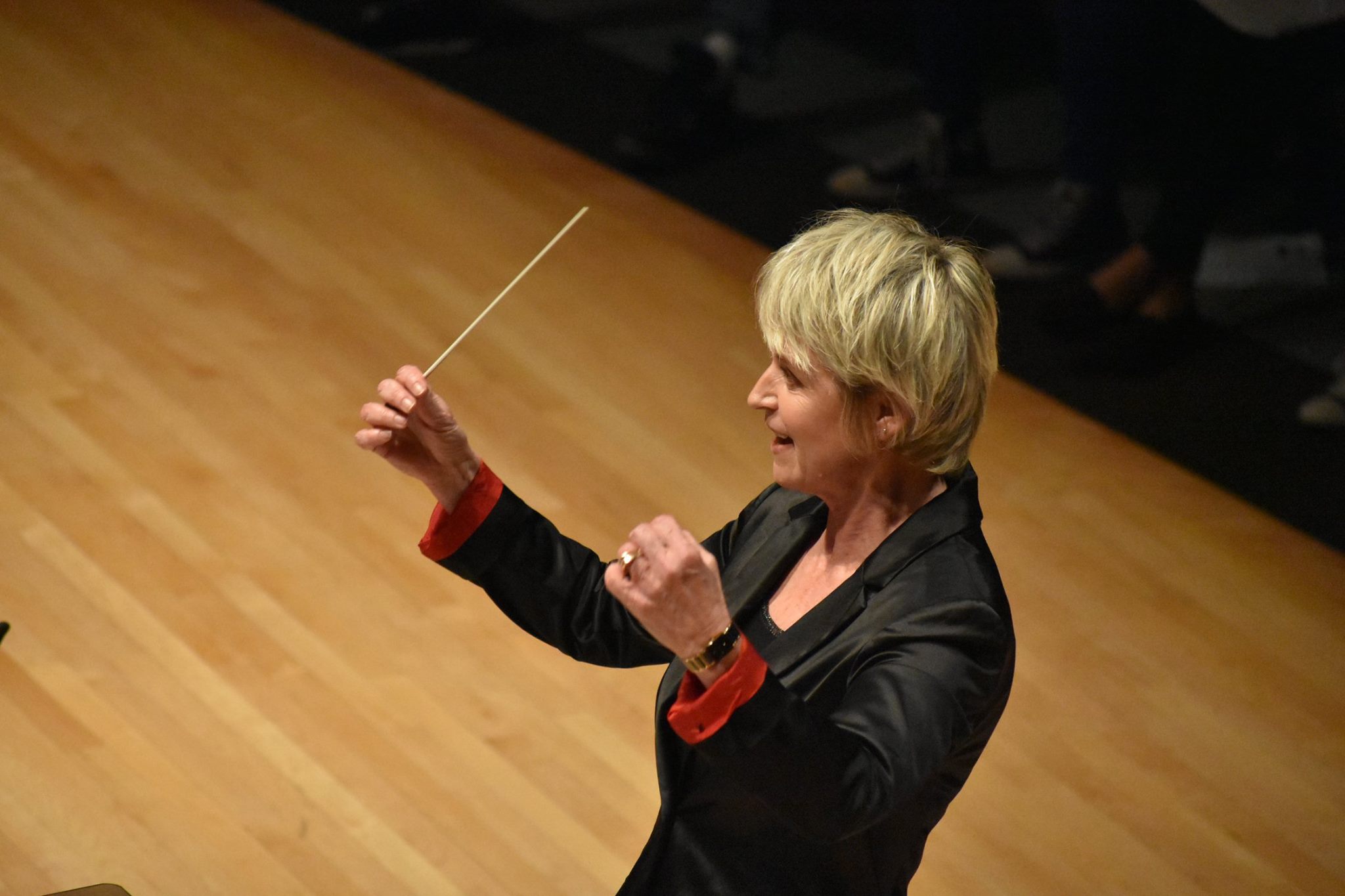
Odds were against Cynthia Johnston Turner becoming a musician let alone a professor of music and conducting in higher education. Born in a small town in Ontario, Canada, no one in her family played an instrument or sang, although there were rumors that her great paternal grandfather was an accomplished mandolinist. Cynthia asked for a piano for Christmas when she was 8 years old, and because it was all her parents could afford, she received a toy electric keyboard from which she was pretty much inseparable until she started the ukulele in grade school. When she picked up the clarinet and saxophone in middle school, a love affair and a career were born. The first in her family to attend university, Cynthia received her Bachelor of Music and Bachelor of Education from Queen’s University, a Master of Education at the University of Victoria, and a Doctor of Musical Arts (Conducting) from the Eastman School of Music. She has received numerous teaching, research, and leadership awards in Canada and the United States.
Cynthia was appointed Dean—Faculty of Music at Wilfrid Laurier University in Waterloo, Ontario July 1, 2021. She leads a school of approximately 400 undergraduate and graduate music majors with programs in traditional conservatory programming coupled with innovative programs such as the Bachelors, Masters, and PhD in Community Music, and Artist Diplomas in Opera Performance, Chamber Music, and the soon to be launched, Master of Music in Collaboration, Creation and Curation (MMC3). She also oversees the Laurier Academy of Music and the Arts, a community-based school serving hundreds of children and their families in the region.
Before her appointment as Dean, Cynthia was Director of Bands, Professor of Music, and Artistic Director of the Contemporary Chamber Ensemble at the Hodgson School of Music, University of Georgia where she conducted the Hodgson Wind Ensemble, led the Master and Doctoral programs in conducting, provided strategic leadership in diversity, equity, and inclusivity initiatives as well as innovative curriculum, and oversaw the entire band program including the 400+ member Redcoat Marching Band. The Hodgson Wind Ensemble performed at the College Band Directors National Association National Convention in 2017. Prior to UGA, Cynthia was Director of Wind Ensembles at Cornell University in Ithaca, New York. She was recently appointed as Artistic Director and Conductor of Festival Winds of “Summer Music at Saugeen Shores.”
Cynthia has guest conducted bands, new music ensembles, and orchestras professionally, at several universities and conservatories, and state honor bands in the United States and abroad. She continues to actively promote commissions by today’s leading and emerging composers around the world with a focus on underrepresented voices. She has been invited to present her research with teaching and technology, innovative rehearsal techniques, and service-learning and music performance at numerous conferences nationally and internationally. She is published in such journals as Interdisciplinary Humanities, International Journal of the Humanities, Music Educators Journal, National Association for Music Education “Teaching Music,” NewMusicUSA.org, Journal of the World Association of Bands and Ensembles, Fanfare Magazine, and Canadian Winds, and has recorded CDs with the Innova and Albany labels.
Cynthia has served as a board member with the World Association of Symphonic Bands and Ensembles (WASBE) and is an active member of College Band Directors National Association (CBDNA), Conductor’s Guild, College Music Society, Humanities Education and Research Association, the National Association for Music Education, and the American Bandmasters Association. She currently serves on the board of the Western International Band Clinic (WIBC) and is faculty at WIBC University. She serves on the advisory boards of the Institute for Composer Diversity (composerdiversity.com), Lift Music Fund (liftmusicfund.org), and United Sound Music (unitedsoundmusic.org). She is an honorary member of Kappa Kappa Psi and a National Arts Associate member of Sigma Alpha Iota. Cynthia is a sponsored clinician with Conn-Selmer.
Spitfire Brass Quintet
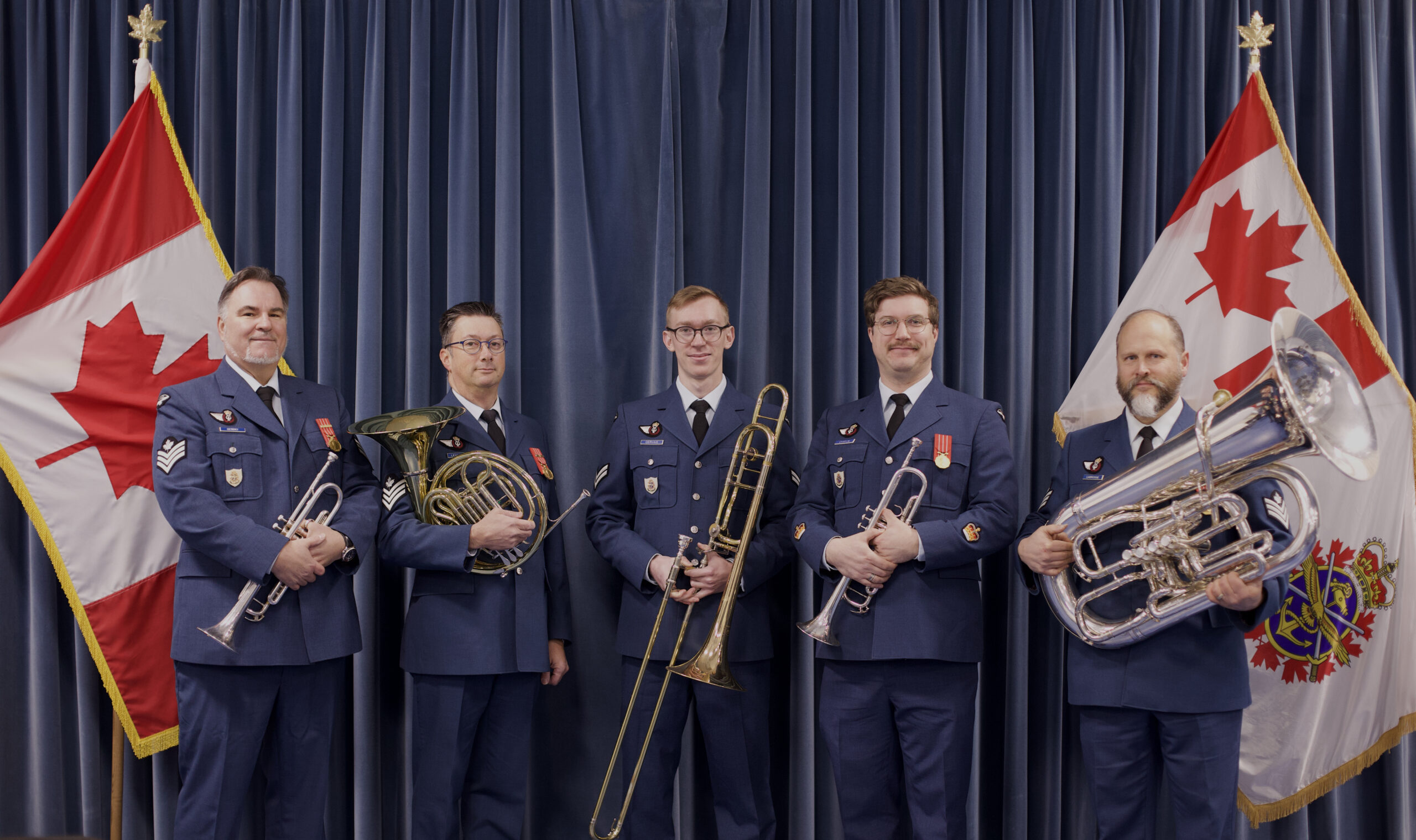
The Spitfire Brass Quintet is composed of members of the Central Band of the Canadian Armed Forces, one of Canada’s six full-time, professional military bands. Based in Ottawa, Ontario, the quintet performs at state occasions and military ceremonies, supports morale and esprit de corps through playing at military social events and mess dinners, and entertains and connects with the public through outreach and educational programming.
The members of the Spitfire Brass Quintet are all serving members of the Canadian Armed Forces, and also active members of the Ottawa music community, appearing regularly with local professional orchestras and other ensembles. They are: Warrant Officer Alastair Chaplin, trumpet; Sergeant Christopher Gerdei, trumpet; Sergeant Michel Levasseur, horn; Sergeant Martin Labrosse, tuba; and Corporal Samuel Gervais, Trombone.
Triumphal March from “Aida”
Giuseppe Verdi, arr. Douglas A. Richard
Paean: Triumph
Steven Bryant
New York Cityscape
Jeff Tyzik
The Spitfire Brass Quintet
I. Ragtime Redux (28th & 5th)
III. Traffic Jammin’ (Times Square Day & Night)
II. Tango (103rd & Riverside)
V. Tarantella (Mulberry Street)
~ INTERMISSION ~
Symphony No. 4
David Maslanka
PICCOLO
Greg Stroh
FLUTE
Tawnya Convoy
Jennifer Pigott
Raven Revelle
Greg Stroh
James Warrington
OBOE/ENGLISH HORN
Zakariya Elmasri
Davis Po
ShaoEn Tang
BASSOON
Ginny Scarfino
Joe Schwarz
CONTRABASSOON
Graham Martin
Eb Clarinet
Chris Todd
CLARINET
Cathy Baer
Jacob Blais
Anita Brooks Kirkland
Larry Moser
Allison Nelson
Cait Nishimura
Kelsey Regier
Lousie Sims
Chris Todd
ALTO CLARINET
Allison Nelson
BASS CLARINET
Bea Gratton
SAXOPHONE
Danielle Beck
Paula Kokot
Sarah Robertson
Tamia Royer
TRUMPET
Gus Bolton
Eric Dettweiler
Matthew Lepain
Erik McIntyre
Aidan Pierotti
Angela Taborda
FRENCH HORN
Hayley Burgess
Christine Donohue
Emma Easton
Debbie Lowes
Isaac Shantz
TROMBONE
David Cooper
Carolyn Culp
Susan Follows
Susan Lee
John Monkhouse
EUPHONIUM
Jamie Kuhl
Chris Phillis
TUBA
Eric Probst
Dennis Scheel
Owen Vince
STRING BASS
Andrew Kotsky
HARP
Daniella Kistemaker
PERCUSSION
Brett Lipson
Graeme McMath
Marlee MacDougall
Easton Page
Man-Yee Sun
Todd Sweezey
PIANO
Sam Domzella
Triumphal March from “Aida”
Giuseppe Verdi, arr. Douglas A. Richard
Aida, Verdi’s grandest spectacle and one of the most popular operas ever written, was intended to celebrate the opening of the Suez Canal and the Cairo Grand Opera House in 1869. The premiere was delayed for almost two years, however, not only because of Verdi’s stringent demands but also because the Franco-Prussian War of 1870 made it impossible to ship the sumptuous costumes and sets to Cairo from Paris, where they were constructed. Terrified of sea voyages, Verdi refused to attend the brilliant premiere in Cairo on Christmas Eve 1871, but supervised the first Italian performances at Milan’s La Scala six weeks later.
Act II closes with a spectacular scene that includes the grand Triumphal March (“Glory to Egypt”), whose noble strains and majestic gait so inspired the Egyptian authorities that it was adopted as the national hymn of that country soon after the premiere.
-Program Notes by Elin Thomas for the Ohlone Concert Band
Paean: Triumph
Steven Bryant
It won’t take a discerning ear to hear Steven Bryant’s clever and brilliant re-imagining of Verdi’s Triumphal March but you may be surprised to hear where he takes us. He changes the harmonic language (it is composed entirely using the whole tone scale. Most Western Classical Music, and certainly most Italian operas are based on Major or minor scales.) and manipulates the rhythmic landscape in imaginative and sometimes, highly dramatic ways.
New York Cityscapes
Jeff Tyzik
New York Cityscapes (2008) was composed as a collaboration between Canadian Brass and the Eastman Wind Ensemble, dedicated to Mark Davis Scatterday, the current director of the Eastman Wind Ensemble. New York Cityscape is a suite of musical styles and sounds connected with New York, with each of the movements linked to a specific location.
Traffic Jammin’ (Times Square Night & Day) captures the many moods of Times Square throughout the day – from crowded and intense to empty and lonely. The contrasts are caught in rock, funk, and jazz styles, complete with a siren and police whistle. Tarantella (Mulberry Street), capturing the vivacious bustle of Little Italy, is based on the old Italian dance that was believed to cure the poisonous bite of the tarantula spider.
– Program Note from University of North Texas concert program, 12 February 2019
Symphony No. 4
David Maslanka
The sources that give rise to a piece of music are many and deep. It is possible to describe the technical aspects of a work — its construction principles, its orchestration — but nearly impossible to write of its soul-nature except through hints and suggestions.
The roots of Symphony No. 4 are many. The central driving force is the spontaneous rise of the impulse to shout for the joy of life. I feel it is the powerful voice of the Earth that comes to me from my adopted western Montana, and the high plains and mountains of central Idaho. My personal experience of the voice is one of being helpless and torn open by the power of the thing that wants to be expressed — the welling-up shout that cannot be denied. I am set aquiver and am forced to shout and sing. The response in the voice of the Earth is the answering shout of thanksgiving, and the shout of praise.
Out of this, the hymn tune Old Hundred, several other hymn tunes (the Bach chorales Only Trust in God to Guide You and Christ Who Makes Us Holy), and original melodies which are hymn-like in nature, form the backbone of Symphony No. 4.
To explain the presence of these hymns, at least in part, and to hint at the life of the Symphony, I must say something about my long-time fascination with Abraham Lincoln. Carl Sandburg’s monumental Abraham Lincoln offers a picture of Lincoln in death. Lincoln’s close friend, David Locke, saw him in his coffin. According to Locke, his face had an expression of absolute content, of relief at having thrown off an unimaginable burden. The same expression had crossed Lincoln’s face only a few times in life; when after a great calamity, he had come to a great victory. Sandburg goes on to describe a scene from Lincoln’s journey to final rest at Springfield, Illinois. On April 28, 1865, the coffin lay on a mound of green moss and white flowers in the rotunda of the capitol building in Columbus, Ohio. Thousands of people passed by each hour to view the body. At four in the afternoon, in the red-gold of a prairie sunset, accompanied by the boom of minute guns and a brass band playing Old Hundred, the coffin was removed to the waiting funeral train.
For me, Lincoln’s life and death are as critical today as they were more than a century ago. He remains a model for his age. Lincoln maintained in his person the tremendous struggle of opposites raging in the country in his time. He was inwardly open to the boiling chaos, out of which he forged the framework of a new unifying idea. It wore him down and killed him, as it wore and killed the hundreds of thousands of soldiers in the Civil War, as it has continued to wear and kill by the millions up to the present day. Confirmed in the world by Lincoln, for the unshakable idea of the unity of all the human race, and by extension the unity of all life, and by further extension, the unity of all life with all matter, with all energy and with the silent and seemingly empty and unfathomable mystery of our origins.
Out of chaos and the fierce joining of opposite comes new life and hope. From this impulse I used Old Hundred, known as the Doxology — a hymn to God; Praise God from Whom all Blessings Flow; Gloria in excelsis Deo — the mid-sixteenth century setting of Psalm 100.
I have used Christian symbols because they are my cultural heritage, but I have tried to move through them to a depth of universal humanness, to an awareness that is not defined by religious label. My impulse through this music is to speak to the fundamental human issues of transformation and re-birth in this chaotic time.
– Program Note by composer