

April 24th, 2026, 7:30 PM
Theatre Auditorium, Wilfrid Laurier University
Cynthia Johnston Turner, Artistic Director & Conductor
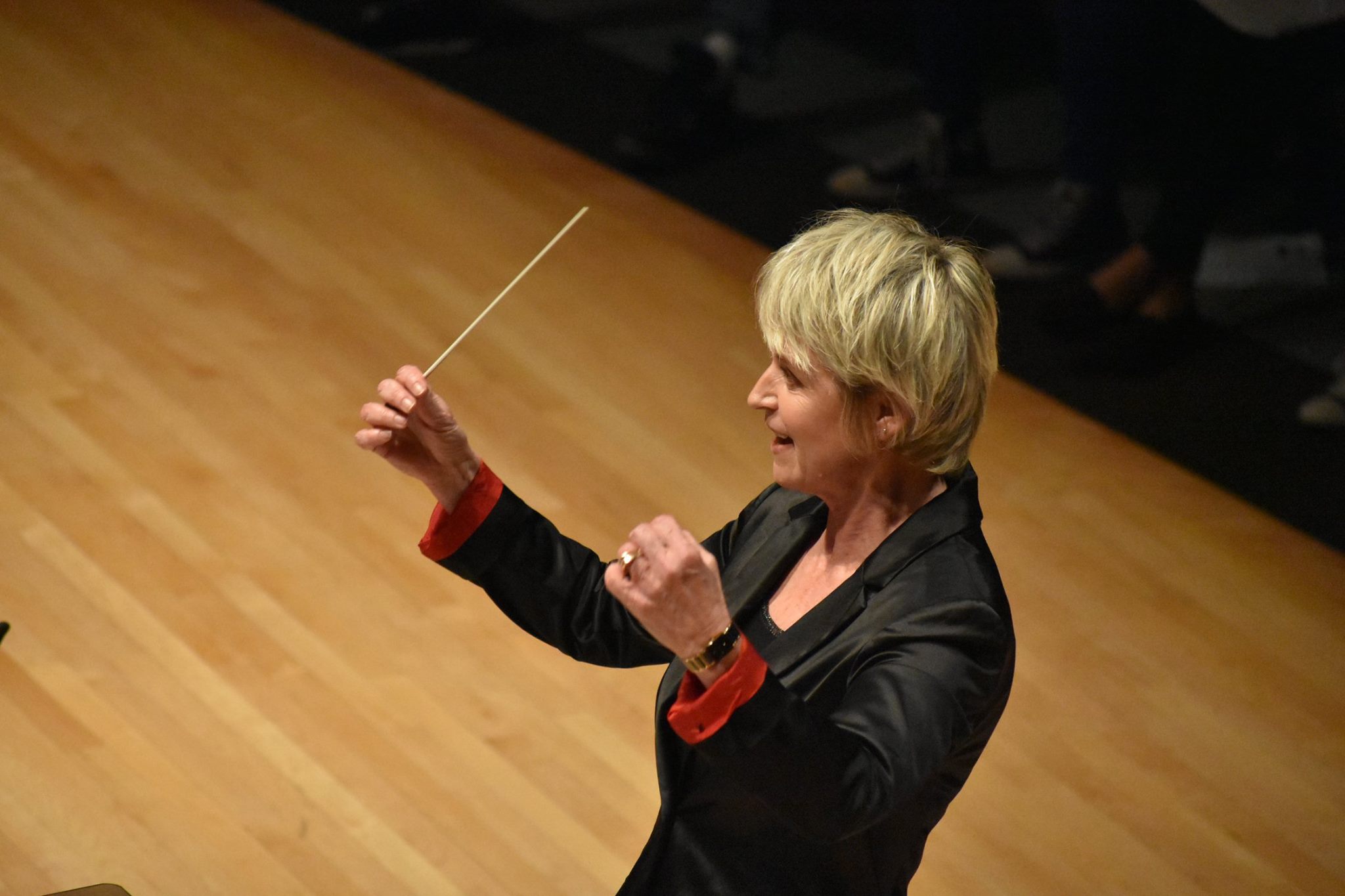
Odds were against Cynthia Johnston Turner becoming a musician let alone a professor of music and conducting in higher education. Born in a small town in Ontario, Canada, no one in her family played an instrument or sang, although there were rumors that her great paternal grandfather was an accomplished mandolinist. Cynthia asked for a piano for Christmas when she was 8 years old, and because it was all her parents could afford, she received a toy electric keyboard from which she was pretty much inseparable until she started the ukulele in grade school. When she picked up the clarinet and saxophone in middle school, a love affair and a career were born. The first in her family to attend university, Cynthia received her Bachelor of Music and Bachelor of Education from Queen’s University, a Master of Education at the University of Victoria, and a Doctor of Musical Arts (Conducting) from the Eastman School of Music. She has received numerous teaching, research, and leadership awards in Canada and the United States.
Cynthia was appointed Dean—Faculty of Music at Wilfrid Laurier University in Waterloo, Ontario July 1, 2021. She leads a school of approximately 400 undergraduate and graduate music majors with programs in traditional conservatory programming coupled with innovative programs such as the Bachelors, Masters, and PhD in Community Music, and Artist Diplomas in Opera Performance, Chamber Music, and the soon to be launched, Master of Music in Collaboration, Creation and Curation (MMC3). She also oversees the Laurier Academy of Music and the Arts, a community-based school serving hundreds of children and their families in the region.
Before her appointment as Dean, Cynthia was Director of Bands, Professor of Music, and Artistic Director of the Contemporary Chamber Ensemble at the Hodgson School of Music, University of Georgia where she conducted the Hodgson Wind Ensemble, led the Master and Doctoral programs in conducting, provided strategic leadership in diversity, equity, and inclusivity initiatives as well as innovative curriculum, and oversaw the entire band program including the 400+ member Redcoat Marching Band. The Hodgson Wind Ensemble performed at the College Band Directors National Association National Convention in 2017. Prior to UGA, Cynthia was Director of Wind Ensembles at Cornell University in Ithaca, New York. She was recently appointed as Artistic Director and Conductor of Festival Winds of “Summer Music at Saugeen Shores.”
Cynthia has guest conducted bands, new music ensembles, and orchestras professionally, at several universities and conservatories, and state honor bands in the United States and abroad. She continues to actively promote commissions by today’s leading and emerging composers around the world with a focus on underrepresented voices. She has been invited to present her research with teaching and technology, innovative rehearsal techniques, and service-learning and music performance at numerous conferences nationally and internationally. She is published in such journals as Interdisciplinary Humanities, International Journal of the Humanities, Music Educators Journal, National Association for Music Education “Teaching Music,” NewMusicUSA.org, Journal of the World Association of Bands and Ensembles, Fanfare Magazine, and Canadian Winds, and has recorded CDs with the Innova and Albany labels.
Cynthia has served as a board member with the World Association of Symphonic Bands and Ensembles (WASBE) and is an active member of College Band Directors National Association (CBDNA), Conductor’s Guild, College Music Society, Humanities Education and Research Association, the National Association for Music Education, and the American Bandmasters Association. She currently serves on the board of the Western International Band Clinic (WIBC) and is faculty at WIBC University. She serves on the advisory boards of the Institute for Composer Diversity (composerdiversity.com), Lift Music Fund (liftmusicfund.org), and United Sound Music (unitedsoundmusic.org). She is an honorary member of Kappa Kappa Psi and a National Arts Associate member of Sigma Alpha Iota. Cynthia is a sponsored clinician with Conn-Selmer.
Wellington Wind Symphony Mentorship Program
This year, the Wellington Wind Symphony is proud to continue our new mentorship program! On this concert, we have invited interested high school students from the Waterloo Region to join us for a piece. They have been attending rehearsals, and sitting side by side to play on The Moon in Her Eyes by Julie Giroux, with Wellington players.
Our hope is that this has been a valuable experience, giving students insight into the rehearsal process, and helping to shape their sound concept. We have certainly enjoyed having them join us!
Please be sure welcome these fabulous students to the stage, and congratulate them on their work this concert cycle!
Terpsichore
Fisher Tull
The Moon in Her Eyes
Julie Giroux
Guest Conductor: Erin Probst
High School Mentorship Students
Overture to Orpheus in the Underworld
Jacques Offenbach, arr. Lawrence Odom
~ INTERMISSION ~
Wine Dark Sea: Symphony for Band
John Mackey
i. Hubris
ii. Immortal thread, so weak
iii. The attentions of souls
PICCOLO
Greg Stroh
FLUTE
Tawnya Convoy
Jennifer Pigott
Raven Revelle
Greg Stroh
James Warrington
OBOE/ENGLISH HORN
Zakariya Elmasri
Davis Po
ShaoEn Tang
BASSOON
Ginny Scarfino
Joe Schwarz
CONTRABASSOON
Shelly Mercer
Eb Clarinet
Chris Todd
CLARINET
Cathy Baer
Jacob Blais
Bailey Deziel
Anita Brooks Kirkland
Larry Moser
Allison Nelson
Cait Nishimura
Lousie Sims
Chris Todd
Michelle Winters
ALTO CLARINET
Allison Nelson
BASS CLARINET
Bea Gratton
Cait Nishimura
CONTRA-ALTO CLARINET
Lissa Kuzych
CONTRABASS CLARINET
Gavin Warren
SAXOPHONE
Tracey Frank
Paula Kokot
Erin Probst
Sarah Robertson
TRUMPET
Gus Bolton
Eric Dettweiler
Matthew Lepain
Angela Taborda
Julia Vaughan
FRENCH HORN
Scott Clark
Brian Donohue
Christine Donohue
Debbie Lowes
Ryan Wehrle
TROMBONE
David Cooper
Carolyn Culp
Susan Follows
Susan Lee
John Monkhouse
EUPHONIUM
Jamie Kuhl
Chris Phillis
TUBA
Allan Lee
Dennis Scheel
Owen Vince
STRING BASS
George Greer
HARP
Daniella Kistemaker
PERCUSSION
Brett Lipson
Graeme McMath
Marlee MacDougall
Easton Page
Man-Yee Sun
Todd Sweezey
Scott Vernon
PIANO
Sam Domzella
FLUTE
Logan Coe
Forest Heights Collegiate Institute, Kitchener
CLARINET
Lily Milliken
Stratford District Secondary School, Stratford
BASS CLARINET
Stanley Dietrich
Laurel Heights Secondary School, Waterloo
SAXOPHONE
Louise Shin
Bluevale Collegiate Institute, Waterloo
TRUMPET
Ekam Kaler
Centennial Collegiate Vocational Institute, Guelph
FRENCH HORN
Grady Fischer
Stratford District Secondary School, Stratford
Nicolas Seguin
Grand River Collegiate Institute, Kitchener
TUBA
Ruby Bailey
Laurel Heights Secondary School, Waterloo
PERCUSSION
Lucete Lee
Huron Heights Secondary School, Kitchener
Terpsichore
Fisher Tull
Terpsichore is the Greek goddess of dancing, one of the nine Muses of the arts and sciences in Greek mythology. Tull began working on it in 1963 as part of a planned orchestral suite which was eventually abandoned. This version was completed in 1967 and premiered by the Sam Houston State University Symphonic Band at the 7th Annual Contemporary Music Festival in Huntsville. The entire piece is based on a two-note motif.
– Program Note from Heritage Encyclopedia of Band Music
The Moon in Her Eyes
Julie Giroux
Marie Laveau, often referred to as the “Voodoo Queen of New Orleans,” was a legendary figure in 19th-century Louisiana. Renowned for her deep knowledge of Voodoo practices, spiritual healing, and herbal medicine, she gained a reputation for her influence in both the spiritual and social spheres. Laveau’s charisma and skill in blending traditional African spiritual beliefs with Catholicism made her a powerful and enduring symbol of New Orleans’ rich cultural heritage. Many prominent figures sought her out for fortune telling as well as advice. The knowledge gleaned from those same prominent figures would ultimately give her great power, influence and ability to “tell the future”, or at least it seemed so. Between the fortune telling and her voodoo background, very few, if any, challenged her.
I have a history with New Orleans — I played piano bar in New Orleans while attending Louisiana State University. I enjoyed exploring the city, watching artisans and vendors, and taking historical tours. Marie Laveau’s footsteps and ghost tours inspired me to write music for her.
The form of the work is basically A, B, C, D, then ending with a variation of B.
- A is composed to make you physically feel New Orleans, subtitled Laid back and doused with oppressive humidity.
- B — subtitled The Big Easy, which is basically a rendition of how I hear New Orleans.
- C is Love Potion #9. It’s somewhat of a love theme that later goes terribly wrong.
- D is That voodoo, that you do, so well (While I could be quoting Frank Sinatra, I’m instead quoting the character Heddy Lamar, played by Harvey Korman in Blazing Saddles.) It pretty much sounds like Voodoo.
It concludes with a strong recap of The Big Easy, symbolizing Marie Laveau: The Voodoo Priestess of New Orleans, the Influencer, the Myth, and the Legend.
– Program Note by composer
Overture to Orpheous in the Underworld
Jacques Offenbach
The music of this overture is well known throughout world. The plot of the opera, not so well known, concerns the mythological musician Orpheus and his wife, Eurydice. Their domestic life leaves much to be desired, and Orpheus seeks happiness with Chloe, the beautiful shepherdess. His wife is in love with the shepherd, Aristeus, who is Pluto in disguise. On one occasion Eurydice is gathering flowers in the meadow, and by some mischance Orpheus mistakes her for Chloe; his perfidy is discovered, and Eurydice flies to Hades with Aristeus. Orpheus is delighted to have disposed of her so easily, but Popular Opinion demands that he make some effort to recover his spouse. Therefore Orpheus accuses Pluto before Jupiter, and all the gods of Olympus decide to accompany Orpheus to investigate the charges.
Eurydice is hidden in a secret chamber and is guarded by a stupid lout called John Styx. Jupiter, disguised as a fly, enters the chamber and buys Eurydice’s love with the promise of freedom. Pluto is compelled to return her to Orpheus, who is to receive her only if he can reach the river without turning to look at his wife. But Jupiter is plotting to keep Eurydice himself, and he causes a blinding flash of lightning, which forces Orpheus to turn his head and look back. Thus Jupiter retains Eurydice in subjection as a Bacchante, and Orpheus returns happily to Chloe.
Wine-Dark Sea: Symphony for Band
John Mackey
Over the past 10 years, I’ve written all of my music in collaboration with my wife, Abby. She titles nearly all of my pieces, a process that usually involves my writing the music, then playing it for her, after which she tells me what the piece is about. Without her help, “Aurora Awakes” would be “Slow Music Then Fast Music #7 in E-flat.” Sometimes she’ll hear a piece halfway through my writing process and tell me what the music evokes to her, and that can take the piece in a different (and better) direction than I had originally intended. I’ve learned that the earlier she is involved in the process, the better the piece turns out. So with “Wine-Dark Sea,” my symphony for band, I asked for her help months before I ever wrote a note of music.
The commission, from Jerry Junkin and The University of Texas Wind Ensemble, in honor of the 100th anniversary of the Sarah and Ernest Butler School of Music, was for a piece lasting approximately 30 minutes. How could I put together a piece that large? Abby had an idea. Why not write something programmatic, and let the story determine the structure? We had taken a similar approach with “Harvest,” my trombone concerto about Dionysus, the Greek god of wine. Why not return to the Greek myths for this symphony? And since this story needed to be big (epic, even), I’d use the original, truly epic tale of Odysseus, as told thousands of years ago by Homer in The Odyssey.
The full Odyssey, it turned out, was too large, so Abby picked some of the “greatest hits” from the epic poem. She wrote a truncated version of the story, and I attempted to set her telling to music. Here is the story the way Abby outlined it (in three movements), and I set it:
After ten years of bloody siege, the Trojan War was won because of Odysseus’ gambit: A horse full of soldiers, disguised as an offering. The people of Troy took it in as a trophy, and were slaughtered. Odysseus gave the Greeks victory, and they left the alien shores for home. But Odysseus’ journey would take as long as the war itself. Homer called the ocean on which Odysseus sailed a wine-dark sea, and for the Greek king it was as murky and disorienting as its name; he would not find his way across it without first losing himself.
I. Hubris
Odysseus filled his ship with the spoils of war, but he carried another, more dangerous, cargo: Pride. This movement opens with his triumphal march, and continues as he and his crew maraud through every port of call on their way home.
But the arrogance of a conquering mortal has one sure consequence in this world: a demonstration of that mortal’s insignificance, courtesy of the gods. Odysseus offends; Zeus strikes down his ship. The sailors drown. Odysseus is shipwrecked. The sea takes them all.
II. Immortal thread, so weak
This movement is the song of the beautiful and immortal nymph Kalypso, who finds Odysseus near death, washed up on the shore of the island where she lives all alone. She nurses him back to health, and sings as she moves back and forth with a golden shuttle at her loom. Odysseus shares her bed; seven years pass. The tapestry she began when she nursed him becomes a record of their love. But one day Odysseus remembers his home. He tells Kalypso he wants to leave her, to return to his wife and son. He scoffs at all she has given him. Kalypso is heartbroken.
And yet, that night, Kalypso again paces at her loom. She unravels her tapestry and weaves it into a sail for Odysseus. In the morning, she shows Odysseus a raft, equipped with the sail she has made and stocked with bread and wine, and calls up a gentle and steady wind to carry him home. Shattered, she watches him go; he does not look back.
III. The attentions of souls
But other immortals are not finished with Odysseus yet. Before he can reach his home, he must sail to the end of the earth, and make a sacrifice to the dead. And so, this movement takes place at the gates of the underworld, where it is always night.
When Odysseus cuts the throats of the sacrificial animals, the spirits of the dead swarm up. They cajole him, begging for blood. They accuse him, indicting him for his sins. They taunt him, mocking his inability to get home. The spirit of his own mother does not recognize him; he tries to touch her, but she is immaterial. He sees the ghosts of the great and the humble, all hungry, all grasping.
Finally, the prophet Teiresias tells Odysseus what he must do to get home. And so Odysseus passes through a gauntlet beyond the edge of the world, beset by the surging, shrieking souls of the dead. But in the darkness, he can at last see the light of home ahead.
– Program Note by composer